Transition dossier

Industrial Maintenance Technician

The machines don’t keep themselves running. Industrial maintenance is the work of keeping production systems operating, figuring out why they stopped, and getting them safely back into service.

This is partly repair work. It is also troubleshooting.
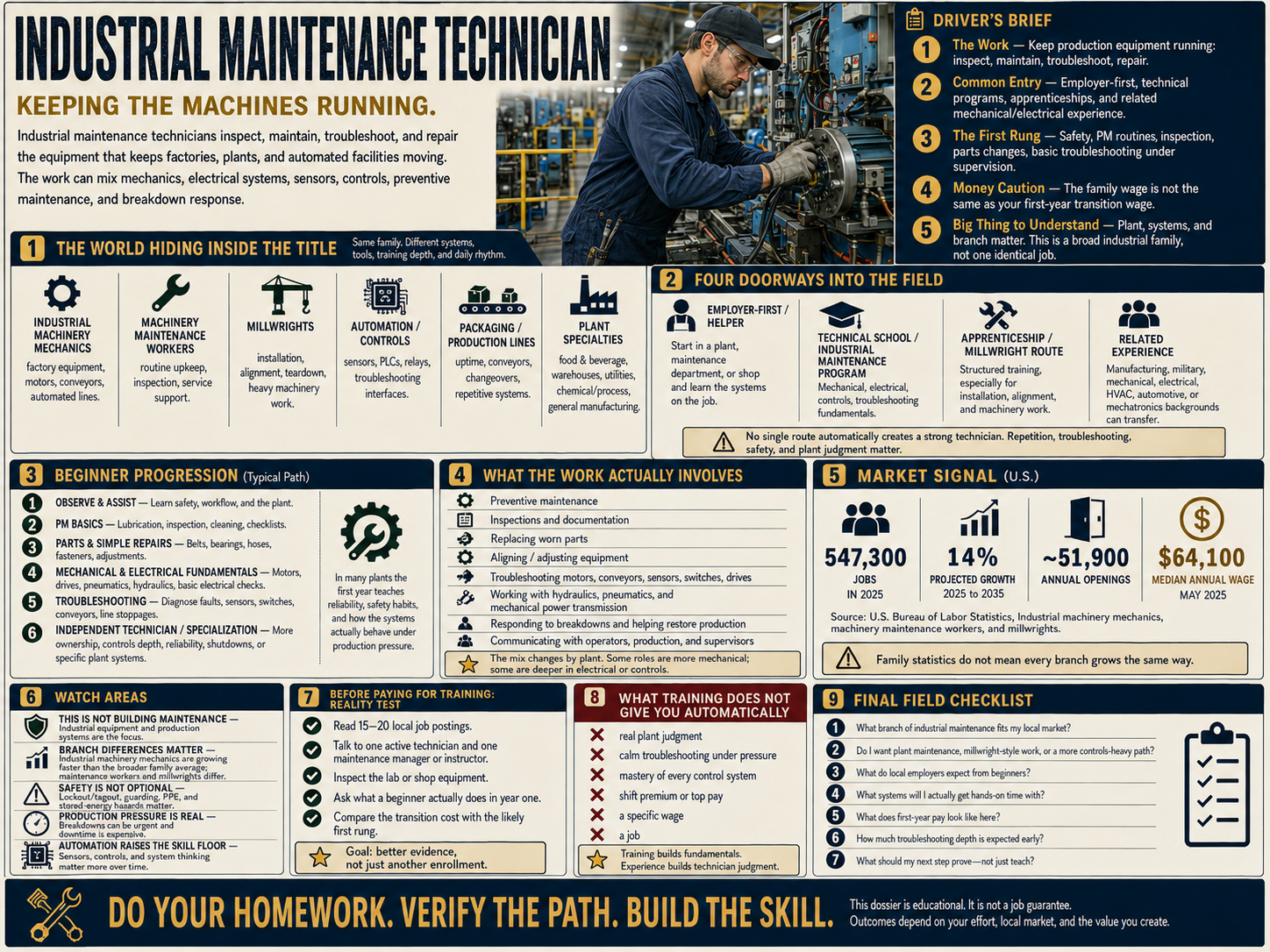
Industrial Maintenance — Atlas Field GuideOne title can hide mechanical, electrical, fluid-power, controls and millwright work.
The workKeep production machinery alive.Inspect, diagnose, repair, align and test industrial systems.
Common entrySeveral real doorways.Employer-first, technical college, apprenticeship in some branches, or adjacent technical experience.
First rungPM before heroics.Inspection, lubrication, basic repairs and assisting experienced technicians.
Money cautionThe headline wage is not the transition wage.Local first-year pay, shifts and development matter.
Hidden branchesMechanical · electrical · hydraulics/pneumatics · PLC/controls · automation · predictive maintenance · millwrightThe plant determines the mix.
Reality testRead 20 local jobs.Then talk to a technician and inspect actual training equipment.
Training cautionKnowledge ≠ plant competence.A course cannot automatically provide shop experience, judgment or a job.
See the field first. Then investigate the doorway.

Atlas gives the map. The dossier below explains where that map gets messy.

What the day is actually like

A plant job with planned work and sudden problems.

The exact mix depends on the plant, shift and equipment. These are the recurring conditions worth noticing.

PeopleSmall teams + solo diagnosisYou may coordinate with operators and other trades, then troubleshoot independently.
RhythmPlanned PM + breakdownsRoutine inspections can be interrupted by equipment failures that suddenly become the priority.
PhysicalActive, hands-on workStanding, reaching, tools, parts, machine access and awkward positions are common.
EnvironmentProduction floorNoise, heat, moving equipment and plant-specific hazards are part of the setting.
ScheduleOften shift-dependentNights, weekends, overtime or call-ins can appear where production runs beyond normal office hours.
FocusFind the real faultTroubleshooting means separating symptoms from causes while production may be waiting.
Tools + computersBothHand tools, meters and schematics can sit beside PLCs, HMIs, laptops and diagnostic software.
When mistakes matterSafety + downtimeA bad diagnosis can create hazards, damage equipment or keep an expensive line stopped.
The title tells you the occupation. This tells you more about how the hours may actually feel.

1. What the work actually involves

Industrial machinery mechanics inspect equipment, read technical documentation, perform diagnostic tests, disassemble machinery, replace failed parts, align or calibrate components and test equipment after repair. Depending on the plant, the work can cross mechanical, electrical, hydraulic, pneumatic and automated systems.

Mechanical systemsMotors, bearings, shafts, pumps, belts, chains, couplings and gearboxes.
Electrical & controlsWiring, relays, starters, sensors, drives, PLC inputs and automated sequences.
Fluid powerHydraulic and pneumatic pumps, valves, cylinders and pressure systems.
Production systemsConveyors, material handling, packaging equipment and plant-specific machinery.
This is not simply “fixing machines with tools.” Troubleshooting is a major part of the craft.

2. The world hiding inside the title

Mechanical maintenanceBearings, shafts, pumps, drives and assemblies.
Industrial electricalMotors, wiring, starters, relays and diagnosis.
Hydraulics / pneumaticsCylinders, valves, pumps and compressed-air systems.
PLC / controlsSensors, controllers, I/O, drives and automated sequences.
Robotics / automationAutomated equipment and interconnected systems.
Predictive maintenanceVibration, temperature and condition signals.
Material handlingConveyors, rollers, belts and controls.
Millwright workInstalling, moving, aligning and rebuilding large machinery.
One title, many jobs. The plant determines the technical mix.

3. Four doorways into the field

Employer-firstStart in junior maintenance and develop under experienced technicians.
Technical collegeBuild structured foundations in mechanical, electrical, hydraulics, pneumatics and controls.
ApprenticeshipPaid work plus instruction, especially relevant in some millwright pathways.
Adjacent experienceAutomotive, machining, HVAC, electrical, military or manufacturing experience may provide a bridge.
None of these routes automatically proves plant competence.

4. What the beginner rung looks like

Observe & assistPM / inspectionComponent workDiagnosisSystem troubleshootingSpecialization

Early work may involve lubrication, inspection, cleaning, preventive maintenance, basic component replacement, learning plant equipment, reading schematics, documenting work and mastering safety procedures.

Training ≠ development. Ask how technical development actually happens inside the employer.

5. Market signal — without the shortage fairy tale

~538K jobsBroad industrial machinery mechanic / maintenance worker / millwright family in 2024.
~54K annual openingsProjected average annual openings across the broad family.
13% broad growthProjected 2024–34 growth across the combined family.
~16% mechanic growthIndustrial machinery mechanics project more strongly than some neighboring roles.

The useful conclusion is not “industrial maintenance is exploding.” Some branches have stronger demand signals than others.

6. Wage reality

The headline wage is not the transition wage.
Occupational statistics can tell youThey cannot tell you
National wage distributionsYour beginner offer
Broad occupational economicsLocal shift premiums and overtime
Established-worker earningsHow fast your employer develops beginners

7. Before paying for training

  1. Read 20 local job postings. Look for repeated requirements.
  2. Talk to one working technician. Ask what a beginner actually does.
  3. Talk to one employer or instructor. Ask what the first rung requires.
  4. Inspect the training equipment. Find out what students physically use.
  5. Compare imagination with evidence.

8. Serious training routes

Orientation / theoryTerminology, safety and foundational concepts.
Technical programStructured classroom and hands-on foundations.
Employer trainingPlant-specific systems and machinery.
ApprenticeshipStructured paid progression plus instruction.
Specialist trainingPLCs, robotics, vibration, alignment or advanced electrical work.

What training does not give you automatically

  • Plant experience
  • Independent troubleshooting competence
  • Familiarity with a specific production line
  • Guaranteed PLC competence
  • A job
  • A particular wage

Sources

What this dossier is for. It explains the work and the transition system around it. It does not decide whether a particular person should enter the field.