Transition dossier

HVAC Technician

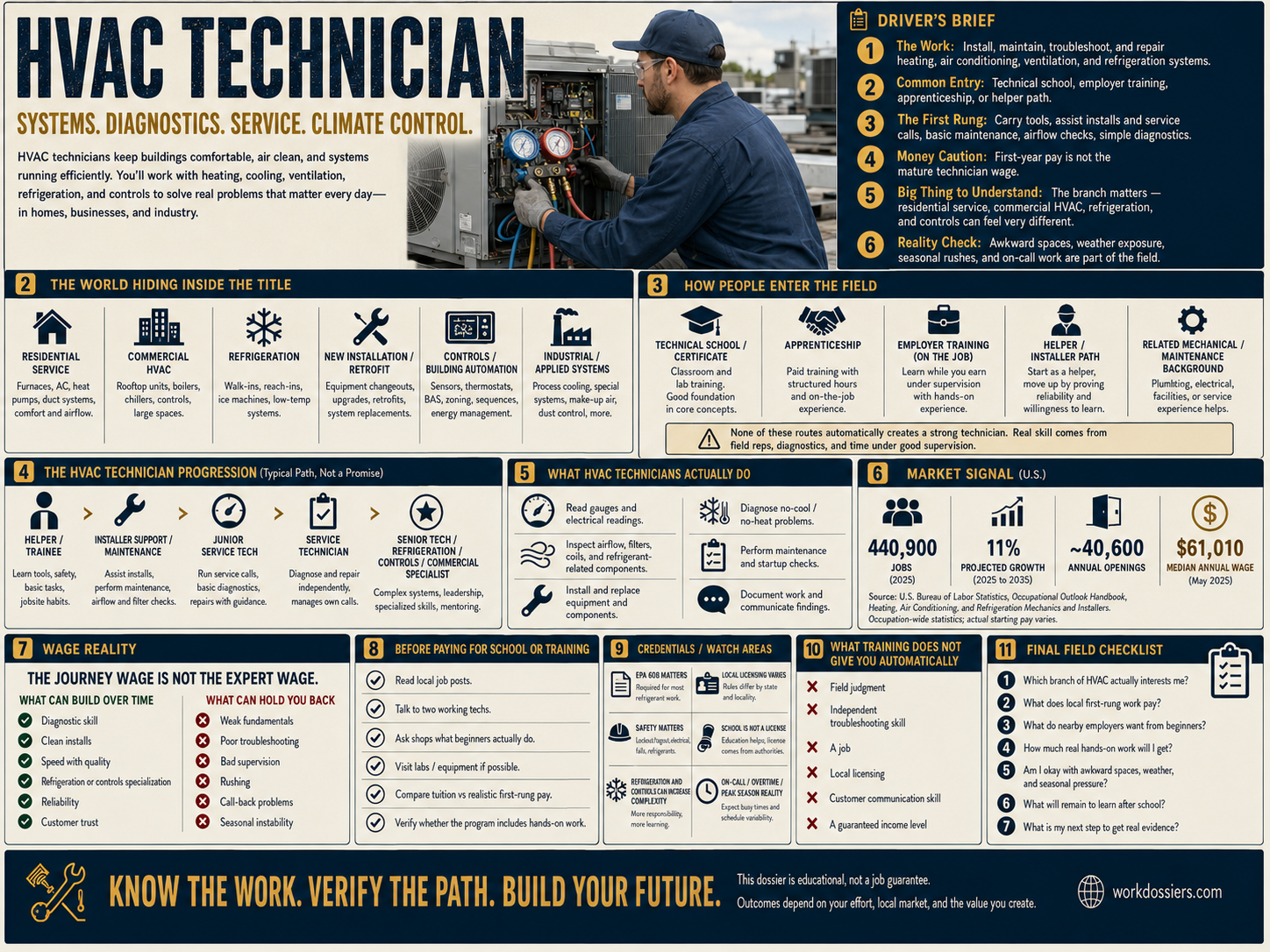
HVAC is not one job. Heating, ventilation, air-conditioning and refrigeration technicians install, maintain, diagnose and repair systems that control temperature, humidity, air quality and refrigeration. Residential service, commercial HVAC, refrigeration, installation and controls can produce very different working lives.

The credential is not the whole trade. The occupational wage is not the first-rung wage.
HVAC Technician — Atlas Field GuideWork reality, entry routes, certification, first-rung economics and the branches hiding inside one title.
The workInstall · maintain · diagnose · repairHeating, cooling, ventilation and refrigeration systems.
Common entrySeveral legitimate routes.Technical school, apprenticeship, employer-first/helper work, or related technical experience.
First rungBasic work before independent diagnosis.Maintenance, install support, cleaning, line insulation, tools and safety.
Certification cautionEPA 608 matters — but it is not the whole trade.It covers refrigerant-handling knowledge, not full field competence.
Hidden branchesResidential · commercial · refrigeration · service · installation · controls / building automationThe branch changes the equipment, schedule and customer environment.
Market signal425,200 jobs · 8% growth · ~40,100 annual openingsNational figures describe the occupation, not the first job.
Money caution$59,810 2024 median ≠ first-rung pay.Local helper/apprentice wages, overtime and seasonality matter.
Understand the branch. Verify the credential. Inspect the training. Then judge the transition.

Atlas gives the structure. The dossier below slows down the parts that generic HVAC career pages often flatten.

What the day is actually like

A mobile technical job where the branch changes almost everything.

Residential service, installation, commercial HVAC, refrigeration and controls can have very different daily patterns.

PeopleCustomers + crews + facility staffResidential work can be highly customer-facing; commercial work may involve property or facility teams.
RhythmCalls, maintenance, installsService is reactive; maintenance is scheduled; installation follows jobsite production.
PhysicalActive and location-dependentLadders, rooftops, attics, crawlspaces, tools and equipment handling may be routine.
EnvironmentHeat, cold, rooftops, mechanical roomsThe system is often located where comfort is worst.
ScheduleSeasonal pressure can biteEvenings, weekends, overtime and on-call work are more likely in service and peak weather.
FocusDiagnose systems, not symptomsElectrical, airflow, refrigeration and controls can interact, so one reading rarely tells the whole story.
Tools + computersStrong mix of bothMeters, gauges and hand tools increasingly sit beside digital controls, apps, BAS software and connected diagnostics.
When mistakes matterSafety + equipment + customer impactElectrical, refrigerant, combustion and installation errors can become costly or dangerous.
Before choosing “HVAC,” find out which branch you are actually imagining.

1. What the work actually involves

HVAC technicians install, maintain and repair heating, ventilation, cooling and refrigeration systems. Common duties include inspecting and testing equipment, installing electrical components and wiring, replacing failed parts, checking performance, handling refrigerants under applicable rules, keeping records and discussing malfunctions with customers.

InstallationEquipment setting, piping, ductwork, electrical connections, commissioning and startup.
Service & diagnosisTemperatures, pressures, electrical checks, airflow, controls, component faults and system behavior.
MaintenanceInspection, cleaning, filters, coils, drains, refrigerant checks and preventive service.
Customer / facility interfaceResidential clients, facility teams, property managers, store operators and other people affected by the system.
HVAC is not just air conditioning. The same broad occupation can involve combustion heating, refrigeration, airflow, electrical troubleshooting, controls, hydronics, heat pumps and building automation.

2. The world hiding inside HVAC

Residential serviceHomes, customer interaction, troubleshooting and seasonal demand.
Residential installationReplacement and new systems, ductwork and jobsite production.
Commercial HVACLarger equipment, rooftops, packaged systems, VRF/VRV and facility environments.
Commercial refrigerationWalk-ins, reach-ins, supermarkets, restaurants and cold-storage systems.
Controls / building automationSensors, controllers, DDC, BAS, communications and system integration.
Testing / balancing / IAQAirflow, measurement, performance verification and indoor-air-quality work.
Branch changes the working life. A residential service technician driving between homes may have a different schedule, customer load, tool mix and technical progression from a commercial refrigeration or controls technician.

3. Four real entry routes

Technical / trade schoolPrograms commonly run from about six months to two years and can provide structured HVACR fundamentals and labs.
ApprenticeshipPaid OJT plus technical instruction over several years. Availability and structure vary by sponsor and location.
Employer-first / helperSome employers hire people with less formal education and develop them through basic work and long-term OJT.
Related experienceElectrical, building maintenance, plumbing, military mechanical work or other technical backgrounds can provide a bridge.
School and apprenticeship solve different problems. School can provide predictable structure before employment. Apprenticeship combines paid work with instruction. Employer-first entry puts someone on real equipment quickly. The useful question is which credible path actually exists locally.

4. What the beginner rung looks like

Observe & assistBasic maintenanceInstall supportElectrical / system checksDiagnosisSpecialization

BLS describes newly hired technicians beginning alongside experienced workers with basic tasks such as insulating refrigerant lines or cleaning furnaces, then moving toward more difficult work such as pipe work and electrical checks.

The first job is part of the training. A certificate may help get someone through the door. It does not remove the long period of field learning required for competent independent work.

5. Market signal — strong, but still local

425,200 jobsU.S. employment in 2024.
8% growthProjected 2024–34 employment growth.
~40,100 openingsProjected average annual openings.
$59,810 medianNational median annual wage in May 2024.

BLS attributes expected growth partly to construction, increasingly sophisticated climate-control systems, repair and replacement work, energy-efficiency upgrades and pollution-reduction efforts. That is a real demand signal, not proof of a good local first job.

Newer wage data are different, not contradictory. BLS OEWS reports a May 2025 national mean annual wage of about $64,780. Mean and median are different statistics, and neither tells a beginner what the first rung pays.

6. Wage reality

The occupational wage is not the first-rung wage.
Occupational statistics can tell youThey cannot tell you
National median / meanYour helper or first-year apprentice rate
Established-worker earningsYour local raise progression
Industry-level wagesOvertime, seasonality and on-call reality
National occupational pictureThe cost of training before or during entry

Career changers often hear about top-out income while living on first-rung pay. The transition has to be evaluated at the bottom of the ladder, not only at the top.

7. EPA Section 608 — important, but understand it

EPA Section 608 rules require technicians who maintain, service, repair or dispose of equipment in ways that could release regulated refrigerants to hold the appropriate certification. The credential is earned by passing an EPA-approved test. Type I, II, III and Universal certifications correspond to different equipment categories.

EPA 608 is a refrigerant-handling credential — not a complete HVAC career certificate. EPA approves certification tests and certifying organizations. It explicitly does not review or approve preparatory training programs or study materials.

Apprentices can be exempt from certification requirements while closely and continually supervised by a certified technician. State or local licensing can add another layer beyond EPA 608.

8. Work reality — where the job happens

Homes & businessesCustomer-facing service, varied buildings and travel between calls.
Rooftops & outdoorsWeather exposure, ladders, heavy equipment and seasonal extremes.
Mechanical roomsNoise, heat, confined access and larger equipment.
Cramped spacesAttics, crawlspaces and other awkward service locations.
Irregular schedulesEvenings, weekends, on-call work and overtime during peak demand.
The physical environment is part of the occupation. BLS notes awkward spaces, outdoor work, extreme temperatures, heavy equipment and comparatively high rates of injury and illness. Those are not footnotes to hide under the salary section.

9. Before paying for school or training

  1. Read 20 local entry-level postings. Separate helper, installer, maintenance, residential service and commercial/refrigeration roles.
  2. Compare school with apprenticeship. Record tuition, duration, paid versus unpaid time, lab exposure and likely first job.
  3. Talk to one technician. Ask what a beginner spends the first six months doing in that branch.
  4. Verify EPA 608 claims. Does the program include an EPA-approved certification test, or only exam preparation?
  5. Inspect the lab. What systems, meters, refrigeration trainers and electrical components do students physically troubleshoot?

10. Serious training routes

Orientation / theoryRefrigeration cycle, electrical basics, terminology and safety.
EPA 608 prep / testingFocused refrigerant-handling knowledge and an approved certification test.
Career technical programBroader classroom and lab instruction, often six months to two years.
ApprenticeshipPaid OJT plus technical instruction.
Employer trainingEquipment, procedures and field practices specific to the company.
Specialty trainingCommercial refrigeration, controls, boilers, VRF, heat pumps and diagnostics.

Interplay Learning remains a serious training candidate because it covers HVAC and related skilled-trade competencies and has a public partner/affiliate channel. Public consumer commission economics remain unverified, so no payout claim or affiliate link is wired.

What training does not give you automatically

  • Independent field competence
  • State or local licensing
  • Customer judgment
  • Experience under seasonal pressure
  • Familiarity with every system
  • A specific wage
  • A job

Sources

What this dossier is for. It explains the work, branches, entry routes, first-rung reality, certification, work environment and training system. It does not decide whether a particular person should become an HVAC technician.