Transition dossier

Engine Builder / Rebuilder

Precision. Measurement. Assembly. Judgment. Engine building lives somewhere between mechanical craft, precision measurement, machining, diagnosis and reputation. Some builders assemble from correctly machined parts. Some machine blocks and cylinder heads. Some do both.

The title sounds simple. The work underneath it is not.
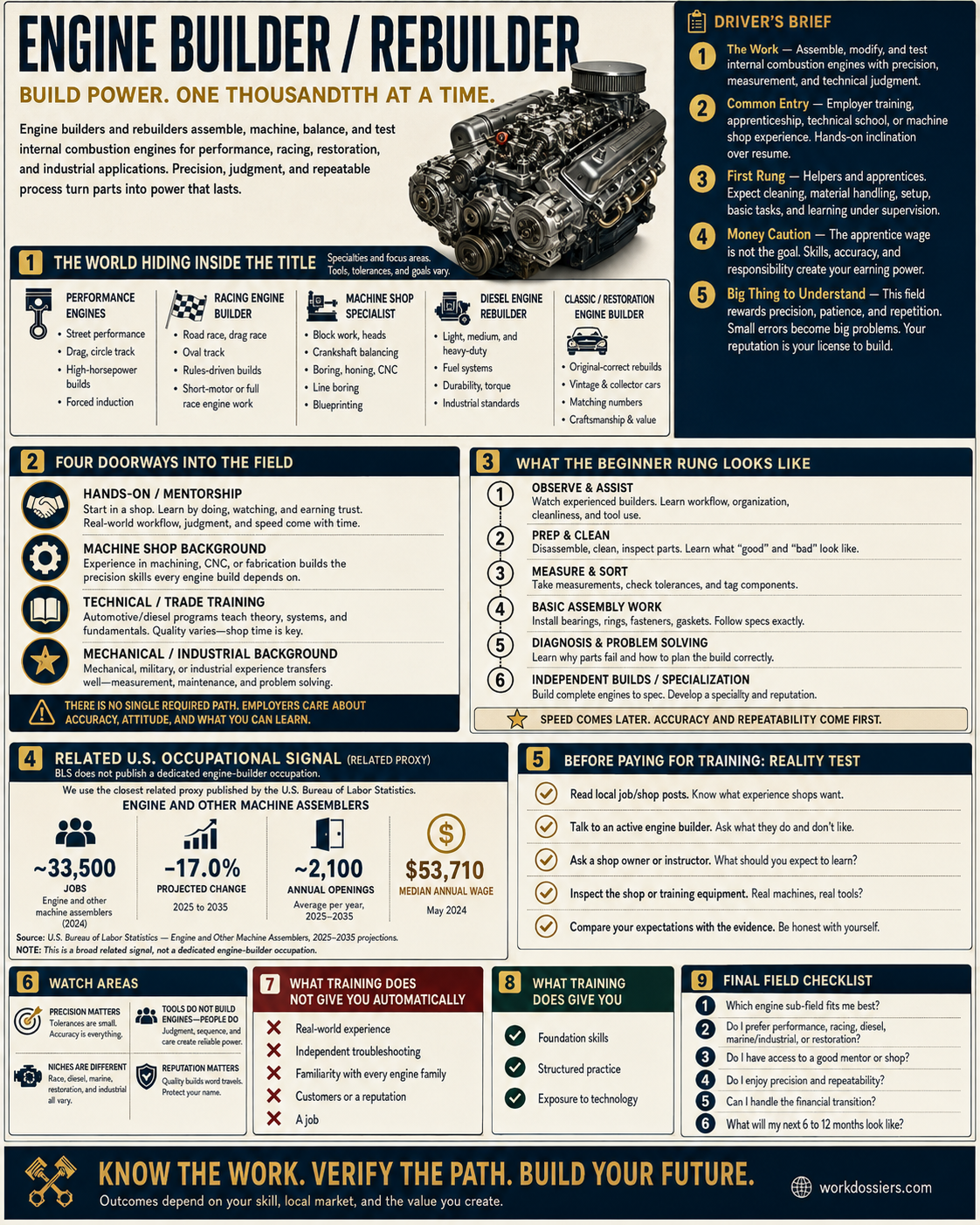
Engine Builder / Rebuilder — Atlas Field GuidePrecision craft with several shop models and no single standardized national entry route.
The workMeasure before you assemble.Cleaning, inspection, metrology, component prep, assembly, testing and sometimes machining.
Common entryShop, mentor, machining or technical training.No universal front door.
First rungClean · organize · measure · assist.Trust grows after repeatable accuracy.
Market cautionNo clean national “engine builder” labor category.Local shop mix and specialty matter more than fake precision.
Hidden branchesPerformance · machine shop · restoration · diesel/heavy-duty · marine · specialty engine familiesAssembly and machining may live in different businesses.
Reality testVisit the shop if permitted.Inspect workflow, measurement discipline, equipment and actual job mix.
Training cautionTools ≠ judgment.Courses cannot automatically supply equipment access, reputation, customers or a job.
Precision first. Reputation later. Verify the actual shop ecosystem.

Atlas gives the working map without inventing a tidy national labor market that does not exist.

What the day is actually like

Slow enough to measure. Busy enough that mistakes get expensive.

The shop model matters: assembly, machining, performance and rebuilding change the mix.

PeopleSmall-shop coordinationMuch of the work is independent, but builders coordinate with machinists, technicians, customers and parts suppliers.
RhythmSequence mattersClean, inspect, measure, machine or prepare, assemble, verify. Rushing the order creates expensive problems.
PhysicalBench + machine workStanding, lifting components, cleaning, tools and detailed hands-on assembly are common.
EnvironmentShop floorParts cleaners, machine tools, oil, metal, noise and strict cleanliness around precision work.
ScheduleShop-dependentOften regular shop hours, with deadline pressure around race, customer or production work.
FocusPrecision for long stretchesMeasurements, clearances, surfaces and assembly details demand sustained attention.
Tools + computersMostly physical, increasingly digitalMetrology and machine tools sit beside specifications, digital gauges, CNC equipment and sometimes dyno/data systems.
When mistakes matterParts + reputationA small error can ruin components, destroy an engine or damage a shop's credibility.
If the careful, repetitive parts sound boring, notice that now. They are the craft, not the waiting room before the fun.

1. What the work actually involves

Engine builders and rebuilders work to specifications measured in thousandths of an inch — or tighter depending on the component and process. Professional work is less about dramatic wrenching than repeatable measurement, cleanliness, documentation, judgment and quality control.

Disassembly & cleaningDocument, tag, inspect and clean components so measurements mean something.
Inspection & measurementMicrometers, bore gauges, straightness checks, clearances, surface condition and wear.
Machining — when the shop does itBoring, honing, decking, line work, crankshaft/head machining, balancing and other precision operations.
Assembly & testingClearance checking, component preparation, torque procedure, timing, lubrication and testing.
Specs are not suggestions. A small measurement error can become an expensive engine failure.

2. One title, several different businesses

Performance builderAftermarket combinations, power goals, dyno results, race or street applications.
Automotive machine shopPrecision machining and component preparation for other shops, builders and customers.
Restoration rebuilderOriginality, correct parts, longevity and preserving older engines.
Diesel / heavy-dutyTruck, agricultural, industrial and generator engines.
Marine specialistMarine-specific engines and operating environments.
Specialist builderA narrow engine family or competition niche where reputation can travel farther than geography.
Assembly and machining are not the same job. Some builders outsource machine work; other shops do machining and assembly under one roof.

3. How people actually enter

Shop / mentorshipStart around a real engine or machine shop, earn trust, and learn workflow, cleanliness and measurement.
Machining backgroundManual machining, CNC, metrology or industrial machining can provide a strong precision foundation.
Technical trainingAutomotive, diesel, machining or specialist engine-building education can create theory and structured practice.
Adjacent experienceAutomotive repair, diesel, motorsport, military or fabrication experience may help depending on the shop.
There is no universal front door. Real shops may care more about measurement discipline, machining exposure and reliable hands-on work than one credential.

4. What the beginner rung looks like

Observe & assistClean & prepareMeasureBasic assemblyDiagnose & understandIndependent work

A beginner may spend substantial time cleaning parts, organizing, tagging, measuring, checking clearances and assisting experienced builders before being trusted with complete builds.

Speed comes later. A beginner who moves slowly and measures twice is more useful than one who is fast, careless and expensive.

5. Market reality — no fake precision

There is no clean U.S. labor category for the specialty performance/restoration engine builder this dossier is describing. O*NET includes “Engine Builder” under the broader Engine and Other Machine Assemblers occupation, while BLS reports that broader industrial category — not the niche engine-shop trade.

What the broad data can and cannot doBLS reported roughly 38,400 workers and a $52,540 median wage in 2024 for the broader Engine and Other Machine Assemblers category. Those numbers include industrial machine assembly and should not be presented as the outlook for independent engine-rebuilding, race, restoration or automotive machine shops.

AERA is better evidence that a distinct trade ecosystem exists: member engine shops, technical education, conferences and an educational foundation supporting people pursuing engine-building/rebuilding careers.

The useful market question is local and specialty-specific. What kinds of engine work actually come through nearby shops?

6. Transition economics

The shop's reputation is part of the pay model.

Engine-building income can depend heavily on the shop, specialty, region, equipment, throughput, reputation and customer base. A beginner may start doing low-value but essential work while proving accuracy and reliability.

What can build valueMeasurement skill, repeatable quality, machining capability, niche engine knowledge, diagnosis, test/dyno knowledge and customer trust.
What can hurt early earningsLow starting responsibility, weak mentorship, limited shop volume, expensive mistakes, narrow local demand and lack of equipment access.

7. Before paying for training

  1. Read 15–20 local shop/job postings.
  2. Talk to one working builder. Ask what a beginner actually does.
  3. Visit or observe a real shop where permitted.
  4. Inspect training equipment. Does the program put students on real engines, measuring tools and machinery?
  5. Compare training with the job.

8. Serious training routes

Shop mentorshipReal workflow, judgment, quality standards and repetition.
Machining educationMetrology, manual/CNC machining, tolerances and precision process.
Automotive / diesel programMechanical fundamentals, diagnostics and engine systems; depth varies.
Specialist engine coursesMeasurement, assembly, blueprinting and performance work.
AERA / industry trainingTrade-specific technical education and scholarship support.

High Performance Academy is one legitimate specialist education candidate identified for this project and publishes an affiliate program. No affiliate link is wired because the final commercial link has not been supplied. AERA's Engine Rebuilders Educational Foundation separately supports industry training through scholarships and grants.

What training does not give you automatically

  • Machine-shop experience
  • Independent build judgment
  • Familiarity with every engine family
  • Access to expensive equipment
  • A reputation
  • Customers
  • A job
  • A particular income

Sources

What this dossier is for. It explains the craft, shop models, entry routes, market uncertainty and training ecosystem. It does not promise that a course turns someone into a professional engine builder.