Transition dossier

CNC Machinist

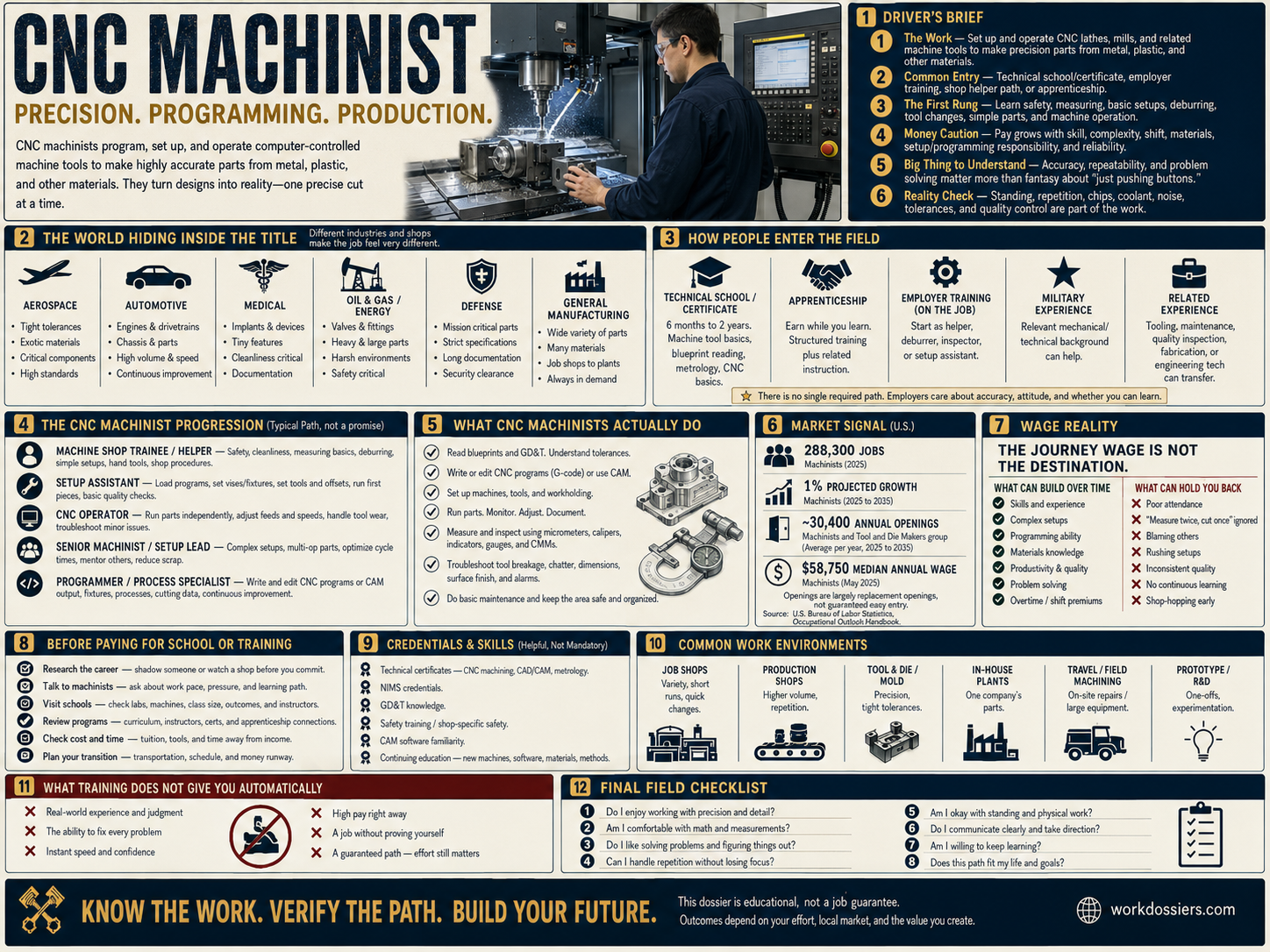
The machine follows instructions. The machinist owns the result. CNC machining sits where drawings, measurement, materials, fixturing, cutting tools, machine setup and software meet. A beginner may start by loading parts and checking dimensions. A strong machinist eventually understands why the process behaves the way it does.

Operator, setup machinist and programmer are related roles—not interchangeable titles.
CNC Machinist — Atlas Field GuideBlueprints, measurement, setup, tooling, process, programming and the shop ladder.
The workMake the part right.Read drawings, set up machines, choose tools, run parts, measure results and correct the process.
Common entrySeveral real doors.Technical school, apprenticeship, employer-first/operator work or related manufacturing experience.
First rungReliability before programming.Part loading, measurement, deburring, offsets, housekeeping and basic setup.
Big cautionA programming certificate does not equal shop trust.Expensive machines and processes are earned responsibility.
Hidden rolesOperator · setup machinist · machinist · programmer · manual/hybrid · advanced specialistTitles overlap. Responsibilities matter more.
Market realityReplacement demand, not a boom.Machinists are projected flat through 2034; broad-family openings come from replacement.
Automation realityTechnology raises productivity and changes the skill mix.CNC is not technology-proof.
Learn the process. Earn the setup. Own the result.

Atlas gives the ladder at a glance. The dossier below explains where operator work becomes process ownership.

What the day is actually like

Precision, repetition and process problems on a shop floor.

The balance changes between operator, setup, machinist and programmer roles, so read the responsibilities—not just the title.

PeopleSmall team, independent machine workYou may coordinate with programmers, inspectors and supervisors while spending long stretches responsible for your own machine or process.
RhythmProduction + setup + troubleshootingRepeated cycles can be routine until dimensions drift, tools wear or a new job needs proving out.
PhysicalStanding and machine-side workLoading parts, changing tools, deburring, measuring and moving around equipment are common.
EnvironmentManufacturing shopMachines, coolant, chips, noise, safety procedures and production targets shape the setting.
ScheduleOften shift-basedPlants may run days, nights, weekends or overtime depending on production demand.
FocusSmall numbers matterTolerances, offsets, tool wear and inspection results reward sustained attention.
Tools + computersBoth, heavilyCutting tools, gauges and fixtures sit beside CNC controls, CAM, drawings and digital inspection systems.
When mistakes matterScrap + crashes + deliveryA missed dimension can scrap parts; a bad setup can damage tools, fixtures or an expensive machine.
The repeated part is real. So is the deeper process work that begins when the repeated part stops behaving.

1. What CNC machinists actually do

Machinists read drawings and specifications, set up and operate machine tools, choose and install cutting tools, position workpieces, monitor the cut, inspect finished parts, make adjustments and troubleshoot problems such as tool wear, chatter, poor surface finish or dimensional drift.

Drawings & tolerancesBlueprints, dimensions, GD&T where relevant, materials and acceptance criteria.
Setup & workholdingFixtures, vises, jaws, zero points, offsets, tool selection and prove-out.
Measurement & qualityMicrometers, calipers, indicators, gauges, CMMs in some shops and inspection records.
Program / processG-code edits, CAM, feeds and speeds, toolpaths, sequence, cycle time and repeatability.
The machine does not remove the need for judgment. Automation can repeat a process efficiently. Somebody still has to understand the drawing, setup, tooling, material, measurement and failure modes well enough to create and maintain that process.

2. Operator, setup machinist, machinist, programmer

CNC operatorLoads parts, runs established programs, monitors the machine, measures parts and makes permitted adjustments.
Setup machinistInstalls workholding and tools, sets offsets, proves the job and prepares production.
CNC machinistCombines operation, setup, measurement, troubleshooting and deeper process understanding.
CNC programmerCreates or edits programs/toolpaths, often using CAM, and works with setup/process decisions.
Manual / hybrid machinistUses conventional machines as well as CNC; manual fundamentals can deepen process understanding.
Advanced specialist5-axis, Swiss, mill-turn, EDM, mold work, aerospace, medical, prototype or other complex manufacturing.
Job titles are not standardized. Read the actual responsibilities, not only the title.

3. How people actually enter

Employer-first / operatorStart on established production and learn measurement, offsets, tooling and shop discipline.
Technical schoolBlueprint reading, metrology, machining fundamentals, CNC operation, setup and sometimes CAM/programming.
ApprenticeshipPaid structured OJT plus technical instruction where available.
Related experienceTooling, fabrication, inspection, aircraft maintenance, mechanical work, 3D printing or manufacturing can provide a bridge.
The boring rung may be the important rung. Shops rarely hand an inexperienced person responsibility for an expensive machine because operator/setup stages teach what makes a process succeed or fail.

4. What the beginner rung looks like

Load / unloadMeasure partsOffsetsSimple setupsTroubleshootProgram / specialize

Entry work can involve material handling, deburring, part loading, cycle monitoring, measurement, tool changes, offset adjustments and basic setup. The educational value depends heavily on whether the shop lets beginners understand why the process works—not merely press Cycle Start forever.

Employment ≠ progression. Some shops develop operators into setup machinists and programmers. Others prefer narrow production roles. Ask how people actually advance inside the shop.

5. Market signal — replacement demand, not a boom

299,500 machinistsU.S. employment in 2024.
0% machinist growthProjected 2024–34.
34,200 openingsAnnual openings for machinists + tool-and-die makers.
$56,150 medianMachinist median wage in May 2024.

The combined machinist/tool-and-die family is projected down 2%, largely because tool-and-die employment is projected down 11%. Machinists specifically are projected essentially flat. The 34,200 annual openings are replacement openings caused by people leaving the occupation or labor force—not net growth.

No shortage fairy tale. Real replacement demand exists inside an occupation where automation increases productivity and limits employment growth.

6. Automation changes the work

BLS says machinists will continue to set up, monitor and maintain CNC machine tools, autoloaders and high-speed machining systems while improvements in those technologies increase worker efficiency and limit employment growth.

Automation can reduce repetitive laborAutomatic tool changers, probing, pallet systems, CAM and process automation can let fewer people produce more parts.
Automation can raise the skill floorComplex setups, process optimization, measurement, programming and troubleshooting become more valuable when machines are more capable.
CNC is not “AI-proof.” It is a technology-heavy manufacturing occupation whose tools keep changing. Investigate how the skill mix is changing rather than pretending the occupation is immune.

7. Wage reality

The machinist median is not the operator offer.
Occupational statistics can tell youThey cannot tell you
Machinist median wageYour production-operator rate
National occupational distributionYour local shift premium or overtime
Experienced-machinist economicsHow quickly setup/programming responsibility arrives
Industry wage differencesWhether the shop rewards skill growth

8. Credentials — useful signals, not shop competence

NIMS currently offers machining credentials across foundational measurement/safety, conventional machining, CNC mill/lathe operations, programming/setup/operations, 5-axis work and EDM.

What a credential can signalExposure to defined competencies, measurement, safety, machine operation, setup or programming knowledge.
What it cannot automatically proveThat you can independently set up an unfamiliar job, prevent a crash, hold tolerance under production pressure or optimize a real shop process.
The shop still has to trust you. A certificate can help earn an interview. Reliable parts, safe setups and good judgment earn responsibility.

9. Before paying for CNC school

  1. Read 20 local postings. Separate operator, setup, machinist and programmer roles.
  2. Talk to two machinists. Ask what separates a good operator from someone ready for setup.
  3. Visit the lab or shop. Find out how much real machine time students receive.
  4. Check the programming claim. Does “CNC programming” mean edits, CAM, prove-out, process planning, or all of those?
  5. Ask where graduates actually start. Operator, setup assistant, trainee or programmer?

10. Serious training routes

Employer / shop trainingActual machines, real production and shop-specific process knowledge.
Technical / community collegeBlueprints, metrology, machining, CNC setup/operation and often CAM.
ApprenticeshipPaid structured development where available.
NIMS credentialsDefined machining competencies across foundational, CNC and advanced areas.
Specialty trainingCAM, 5-axis, Swiss, EDM, probing, inspection, GD&T and other advanced subjects.

This project still has no CNC-specific affiliate education rail verified strongly enough to designate as monetization. The page remains useful without pretending it needs a course button.

What training does not give you automatically

  • Real production judgment
  • Setup confidence
  • Crash avoidance under pressure
  • Familiarity with every controller
  • Independent programming responsibility
  • A high wage
  • A job

Sources

What this dossier is for. It explains the role ladder, first rung, automation reality, labor-market nuance, credentials and training. It does not tell a particular person that CNC is safe, booming or technology-proof.