Biomedical Equipment Technician
Healthcare technology has to work when somebody needs it. BMETs install, inspect, maintain, calibrate, troubleshoot and repair medical equipment. The field sits at the intersection of electronics, electromechanical systems, software, networks, documentation and patient-care environments.
The credential picture is layered. The first job is still the hard proof.
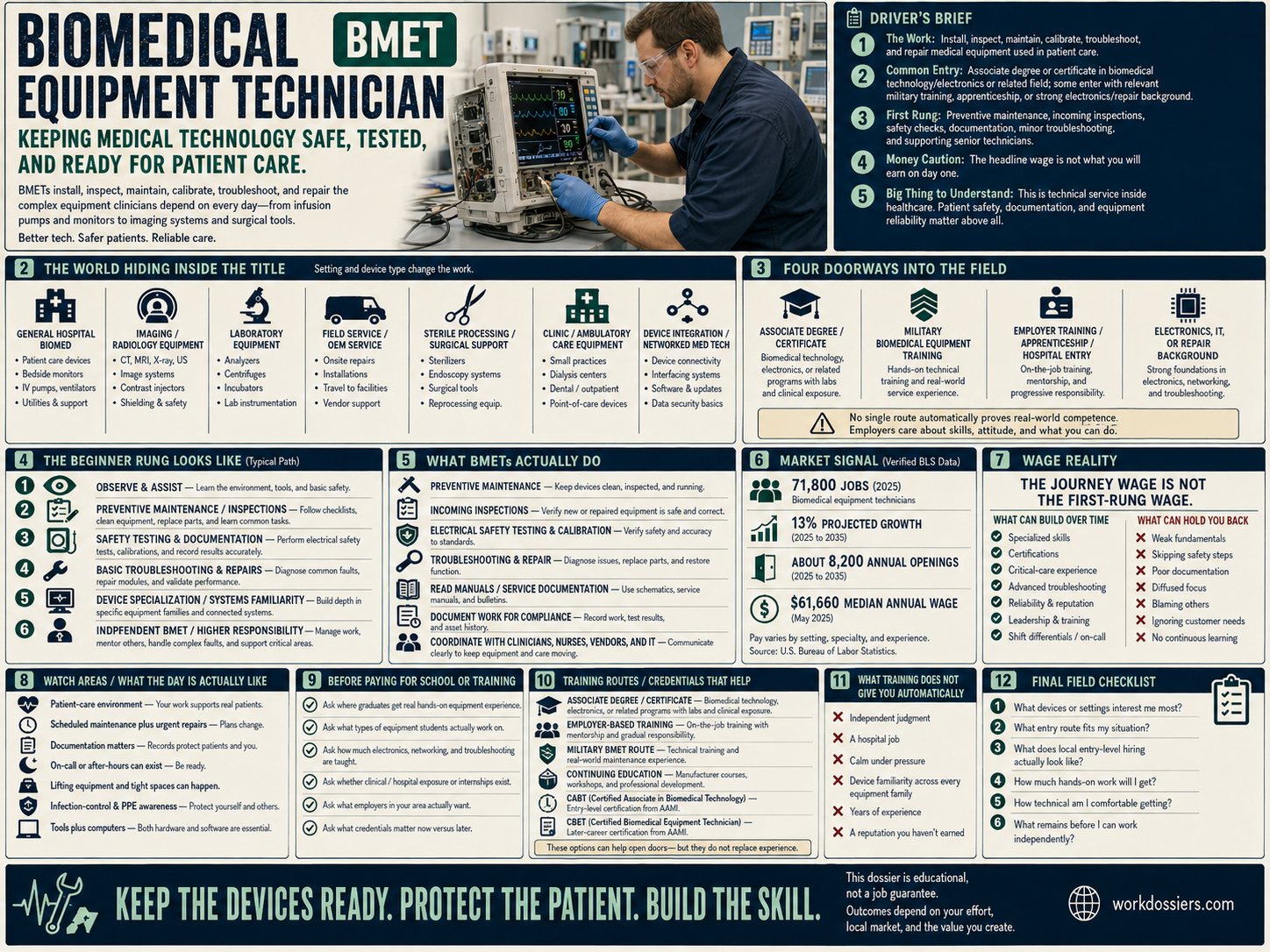
Technical maintenance inside a healthcare system.
The equipment family and employer matter, but reliability, documentation and coordination show up again and again.
1. What the work actually involves
BMETs install equipment, test and calibrate it, perform preventive maintenance, troubleshoot failures, replace parts, document service activity, explain equipment operation and sometimes help evaluate replacement equipment. The devices can combine electronics, mechanical systems, hydraulics, software and network connectivity.
2. What BMETs may actually work on
3. How people enter the field
4. What the beginner rung looks like
BLS says new workers commonly observe experienced repairers for several months and provide help as needed. AAMI's entry-level CABT description centers scheduled maintenance, incoming/routine inspections, support for senior technicians and minor troubleshooting.
5. Market signal — strong, but local entry can still be awkward
BLS expects demand as healthcare facilities continue to rely on equipment for diagnosis, monitoring and treatment. Current practitioner discussions also show that a strong national outlook does not guarantee an easy BMET I opening in every metro.
6. Wage reality
| Occupational statistics can tell you | They cannot tell you |
|---|---|
| National median wage | Your BMET I or apprenticeship offer |
| All experience levels combined | Hospital vs third-party vs OEM pay locally |
| Occupation-wide market | Relocation, travel or on-call burden |
| Established workers | How quickly specialization changes earnings |
Current 2026 practitioner discussions show entry-level offers varying by employer and geography. Those anecdotes are useful evidence that BMET I economics vary; they are not a replacement for local salary research.
7. Credentials — CABT is not CBET
8. Work reality — healthcare changes the maintenance job
9. Before paying for BMET school
- Map the local employers. Hospitals, third-party HTM companies, rental/service firms and OEM field-service organizations.
- Read 20 BMET I / apprentice postings. Track degree requirements, electronics background, travel, on-call and experience expectations.
- Talk to a BMET. Ask how much of the week is PM, repair, paperwork, hunting equipment, travel and clinical coordination.
- Compare school with apprenticeship or employer entry.
- Check credential claims. Is the program preparing for CABT, CBET, or something else — and what experience is still required?
10. Serious training routes
What training does not give you automatically
- Hospital experience
- Independent repair judgment
- Full CBET status
- Imaging competence
- Device-family mastery
- A local opening
- A specific wage
- A job
Sources
- U.S. Bureau of Labor Statistics — Medical Equipment Repairers
- AAMI — BMET Apprenticeship
- AAMI — CABT
- AAMI — CBET