Automation & Controls Technician
Software meets electricity meets machinery. Controls technicians work on the systems that sense, decide and control how automated equipment behaves — and they figure out why that chain is not doing what it should.
PLC programming can be part of the road. It is not the road itself.
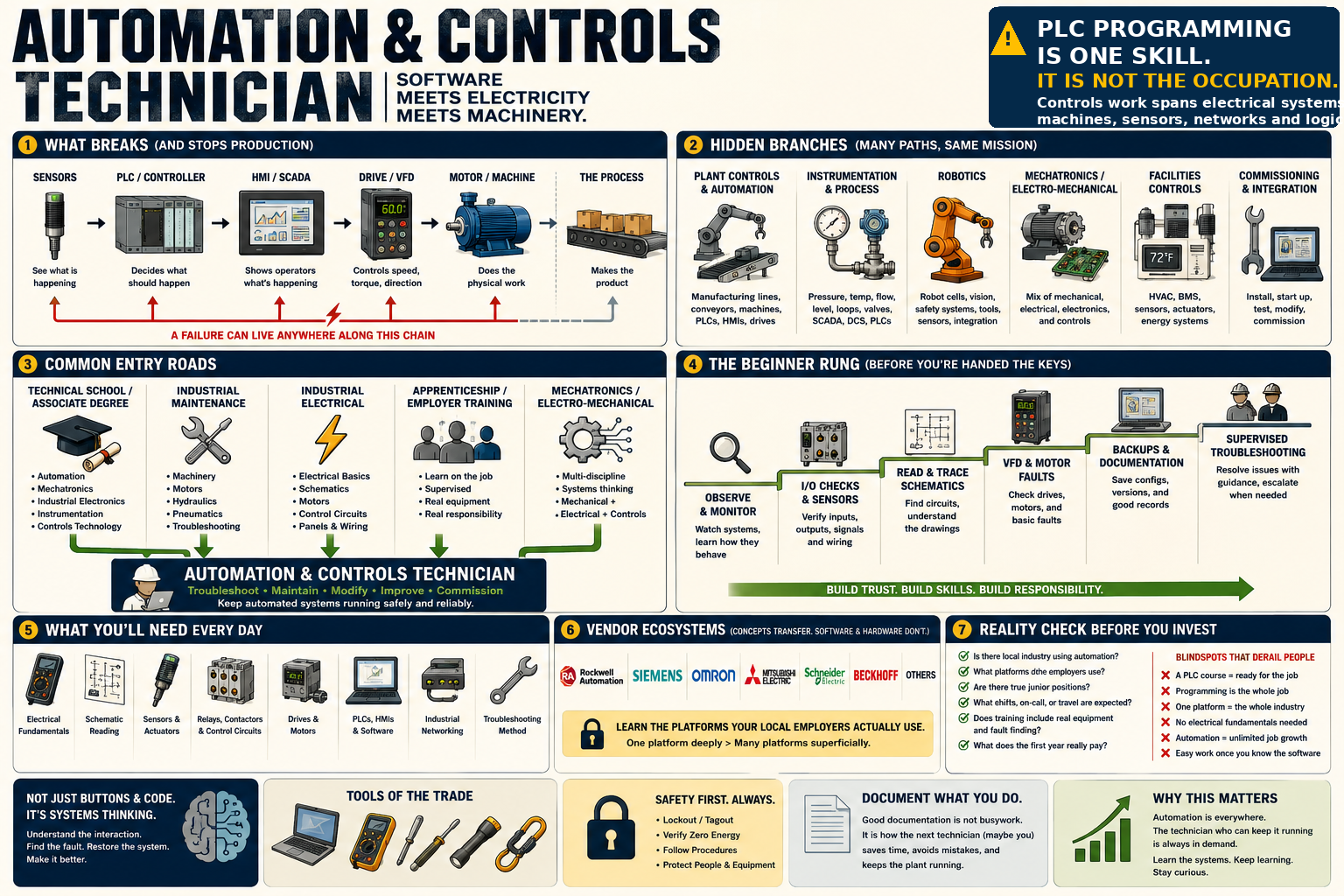
A mixed hardware-and-software job where downtime can rewrite the schedule.
The exact mix depends on the plant, industry, shift and equipment. These are the recurring conditions worth noticing.
1. What the work actually involves
Automation and controls technicians work on the systems that control machines and industrial processes. Typical work can include tracing sensors and inputs, troubleshooting PLC-controlled equipment, checking HMIs, diagnosing VFD and motor-control faults, reading electrical schematics, replacing field devices, checking industrial networks, helping commission equipment, documenting changes and restoring production after faults.
The job is not simply programming. It is not simply electrical work. And it is not ordinary machine maintenance with a laptop added.
2. The hidden branches
3. Controls technician vs industrial maintenance technician
| Industrial Maintenance | Automation & Controls |
|---|---|
| Broader across the machine: mechanical systems, bearings, lubrication, hydraulics, pneumatics, motors, alignment, repairs and controls exposure. | More concentrated on control logic, signals, I/O, sensors, HMIs, drives, instrumentation, networks, sequencing and controller diagnostics. |
There is real overlap. Both may touch sensors, motors, schematics and PLCs. The difference is usually where the responsibility concentrates.
A controls technician may spend more time asking: What does the system believe is happening, what command is it issuing, and where is that chain breaking?
4. Technician or engineer?
A controls technician may edit PLC logic, configure drives, modify HMI screens, commission equipment, troubleshoot networks, recommend hardware changes and improve existing systems. Touching software does not automatically make the role controls engineering.
Engineer-heavy roles are more likely to own original system architecture, major design decisions, specifications, larger automation projects and deeper system-wide technical responsibility. Employers divide the boundary differently.
5. Five doorways into the field
6. What the beginner rung looks like
Early work may involve monitoring PLC and HMI behavior, basic I/O checks, tracing sensors and switches, verifying wiring, reading drawings, checking simple VFD faults, replacing field devices, assisting with preventive maintenance, documenting repairs, backing up configurations and helping with commissioning.
7. PLC programming is one skill, not the occupation
PLC knowledge matters. Ladder logic matters. Controller architecture matters. Knowing how to navigate a programming environment matters.
But real controls troubleshooting may also require electrical fundamentals, sensors and actuators, motors and drives, relays, industrial networking, safety systems, machine sequencing, pneumatics, mechanical understanding, schematics, process knowledge and disciplined documentation.
8. Vendor ecosystems
Industrial controls are fragmented by manufacturer. Common ecosystems include Rockwell / Allen-Bradley, Siemens, Omron, Mitsubishi, Schneider Electric, Beckhoff and multiple robotics and SCADA platforms.
The underlying concepts transfer. The software, hardware, conventions and workflows do not always transfer cleanly.
9. The training ladder
What training does not give you automatically
- Judgment under production pressure
- Experience diagnosing ambiguous failures
- Familiarity with one plant's equipment
- Employer authorization for electrical work
- Responsibility for live systems
- Experience recovering from a bad change
- Trust from experienced technicians
- The instinct to suspect the mechanical problem hiding behind the PLC alarm
10. Market signal and transition economics
There is no clean national BLS occupation named “Automation & Controls Technician.” The title family crosses several classifications, so national numbers need to be treated as proxies rather than a fake controls-tech median.
Automation can reduce some labor requirements while also increasing the need for people who install, maintain, troubleshoot, modify and operate complex automated systems. Both things can be true. Local industry and employer mix matter more than hype.
11. Credentials and legal boundaries
There is no universal national controls-technician license. Employers may value technical certificates, associate degrees, apprenticeships, vendor training and documented industrial experience. None is a universal permission slip.
Electrical work creates an additional boundary. What a controls technician may legally install, modify, energize or repair can depend on jurisdiction, licensing rules, employer policy, supervision and the exact scope of work.
12. Reality test before paying for training
- Pull 20–30 local job postings. Search controls technician, automation technician, PLC technician, mechatronics technician, instrumentation and controls, and industrial automation.
- Track repeated requirements. Beginner vs experienced, degree/certificate, prior maintenance/electrical experience, PLC brands, HMIs, VFDs, robotics, instrumentation, networking, shifts, on-call and travel.
- Inspect the lab. Look for real PLC hardware, HMIs, sensors, motors, drives, control circuits, networking and faults to diagnose.
- Ask what junior technicians actually touch. Do not let an advanced course brochure define the first rung.
- Compare training with the local equipment stack. Vendor familiarity is most useful when it matches nearby employers.
13. Who this work may appeal to
Not because a personality quiz says so. But the work can suit people who enjoy tracing cause and effect, interconnected systems, physical equipment plus software, troubleshooting without an obvious answer, continuous technical learning, careful documentation and switching between abstract logic and real machinery.
It may be less appealing if what you primarily want is predictable desk work, one software stack, little physical-environment exposure, few interruptions, or problems that can comfortably wait until tomorrow.
14. Blindspots
Questions still worth answering
- Which local industries employ controls technicians?
- Which job titles and PLC platforms do those employers actually use?
- Are junior positions genuinely junior?
- Is maintenance or electrical experience normally expected first?
- How common are shifts, nights, on-call and travel?
- Is the local work mainly troubleshooting, programming, commissioning, instrumentation or robotics?
- What does the first year realistically pay?
- What electrical work requires licensed personnel locally?
- What does progression depend on after entry?
Sources
- U.S. Bureau of Labor Statistics — Electro-mechanical and Mechatronics Technologists and Technicians
- O*NET — Robotics Technicians
- O*NET — Electro-Mechanical and Mechatronics Technologists and Technicians
- OSHA — Control of Hazardous Energy
- Rockwell Automation — Training
- Siemens — PLC and automation training